

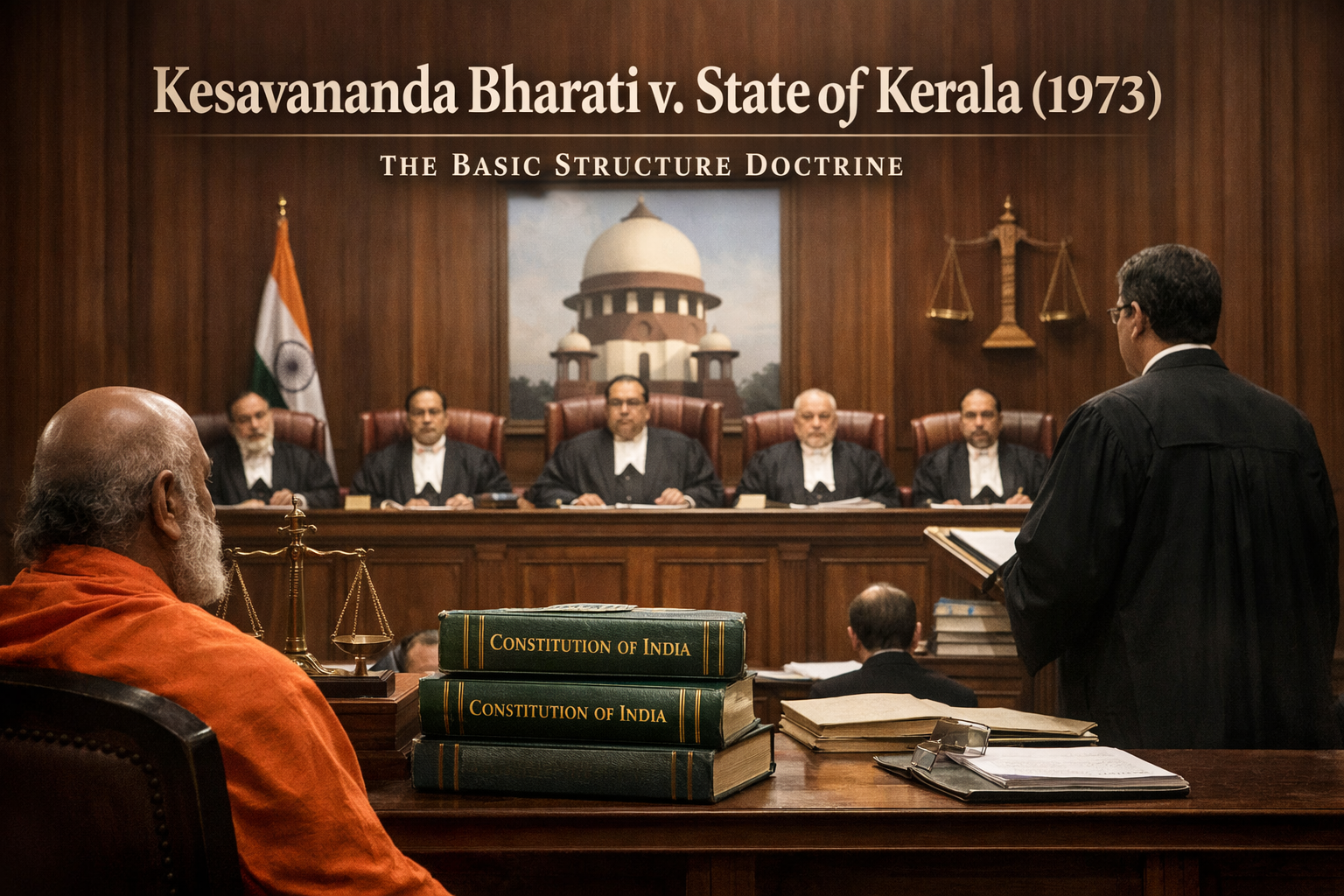
Kesavananda Bharati v. State of Kerala (1973) – The Case That Created the Basic Structure Doctrine
The judgment in Kesavananda Bharati v. State of Kerala (1973) is considered the most important constitutional decision in Indian legal history. It fundamentally changed the relationship between Parliament and the Constitution and introduced the historic Basic Structure Doctrine. This case settled a crucial constitutional question: Does Parliament have unlimited power to amend the Constitution, or are there inherent limits to that power?
This decision continues to protect Indian democracy even today.
Introduction
Kesavananda Bharati v. State of Kerala was decided on 24 April 1973 by a 13 judge bench of the Supreme Court of India, the largest bench ever constituted in Indian judicial history. The case arose during a period of intense constitutional conflict between Parliament and the judiciary over the scope of the power to amend Fundamental Rights.
The core issue was whether Parliament could amend any part of the Constitution, including Fundamental Rights, without limitation.
Facts of the Case
His Holiness Swami Kesavananda Bharati was the head of the Edneer Mutt, a religious institution in Kerala. The Kerala government passed the Kerala Land Reforms Act, 1963, which imposed restrictions on land ownership. The Act directly affected the property owned by the Mutt.
At that time, the Right to Property was guaranteed as a Fundamental Right under Article 31 of the Constitution. The petitioner challenged the constitutional validity of the Kerala Land Reforms Act before the Supreme Court under Article 32, claiming that the law violated his Fundamental Rights.
During the pendency of the case, Parliament passed three important Constitutional Amendments:
The 24th Constitutional Amendment Act, 1971 clarified that Parliament has the power to amend any provision of the Constitution, including Fundamental Rights, under Article 368.
The 25th Constitutional Amendment Act, 1971 curtailed the Right to Property and restricted judicial review in matters of compensation.
The 29th Constitutional Amendment Act, 1972 placed certain Kerala land reform laws into the Ninth Schedule to protect them from judicial review.
The petitioner then challenged not only the Land Reforms Act but also the validity of these constitutional amendments. The dispute thus became a direct confrontation over the limits of Parliament’s amending power.
Issues Before the Supreme Court
The Supreme Court examined the following constitutional issues:
Whether Parliament’s power under Article 368 to amend the Constitution is unlimited.
Whether Parliament can amend or abrogate Fundamental Rights.
Whether there are implied limitations on the amending power of Parliament.
Whether the 24th, 25th and 29th Amendments were constitutionally valid.
Arguments Presented
The petitioner argued that the Constitution is supreme and Parliament, being a creation of the Constitution, cannot destroy its essential features. It was contended that if Parliament were granted unlimited power, it could abolish democracy, eliminate judicial review, or change the basic identity of the Constitution.
On the other hand, the Government argued that Parliament possesses sovereign amending power under Article 368. It was claimed that the amending power is wide and unlimited, and that no implied restrictions should be read into the Constitution.
Judgment of the Court
By a narrow majority of 7:6, the Supreme Court delivered a historic judgment.
The Court held that Parliament has wide powers to amend the Constitution under Article 368. It can amend Fundamental Rights as well. However, Parliament cannot alter, damage or destroy the Basic Structure of the Constitution.
This principle became known as the Basic Structure Doctrine.
The Court did not provide a closed list of what constitutes the basic structure. However, certain essential features were identified, such as:
Supremacy of the Constitution
Republican and Democratic form of Government
Secular character of the Constitution
Separation of Powers
Federal character of the Constitution
Rule of Law
Judicial Review
Independence of the Judiciary
The Court upheld the validity of the 24th Amendment. The 25th Amendment was partly upheld, but the provision excluding judicial review was struck down. The 29th Amendment was upheld but made subject to the Basic Structure test.
Ratio Decidendi
The ratio of the judgment is clear: Parliament has the power to amend the Constitution, but this power is not unlimited. It cannot change the identity or essential framework of the Constitution.
The Constitution remains supreme, and Parliament operates within its boundaries.
Significance of the Case
This case changed Indian constitutional law forever.
It established constitutional supremacy over parliamentary supremacy.
It strengthened the power of judicial review.
It prevented the misuse of constitutional amendment power by temporary political majorities.
It ensured long term stability of Indian democracy.
The Basic Structure Doctrine has been applied in several subsequent cases, including Indira Nehru Gandhi v. Raj Narain and Minerva Mills v. Union of India.
The doctrine acts as a constitutional safeguard against authoritarianism.
Conclusion
Kesavananda Bharati v. State of Kerala represents a turning point in Indian constitutional history. The judgment created a balance between flexibility and stability. It allowed Parliament to amend the Constitution when necessary, but it prevented destruction of its foundational principles.
By introducing the Basic Structure Doctrine, the Supreme Court ensured that democracy, rule of law, and constitutional values would remain protected irrespective of political changes.
Even decades later, this judgment continues to shape constitutional interpretation and remains the cornerstone of Indian constitutional law.
Personal Opinion
In my opinion, this judgment was essential for protecting the long term democratic structure of India. Without limitations on the amending power, a government with a strong majority could have altered the Constitution to suit political interests.
The Basic Structure Doctrine provides a necessary constitutional safeguard. At the same time, the Court did not completely restrict Parliament’s authority. It preserved the balance between democratic will and constitutional integrity.
Kesavananda Bharati is not merely a case about property rights. It is a case about preserving the identity of the Constitution and protecting the democratic future of the nation.